
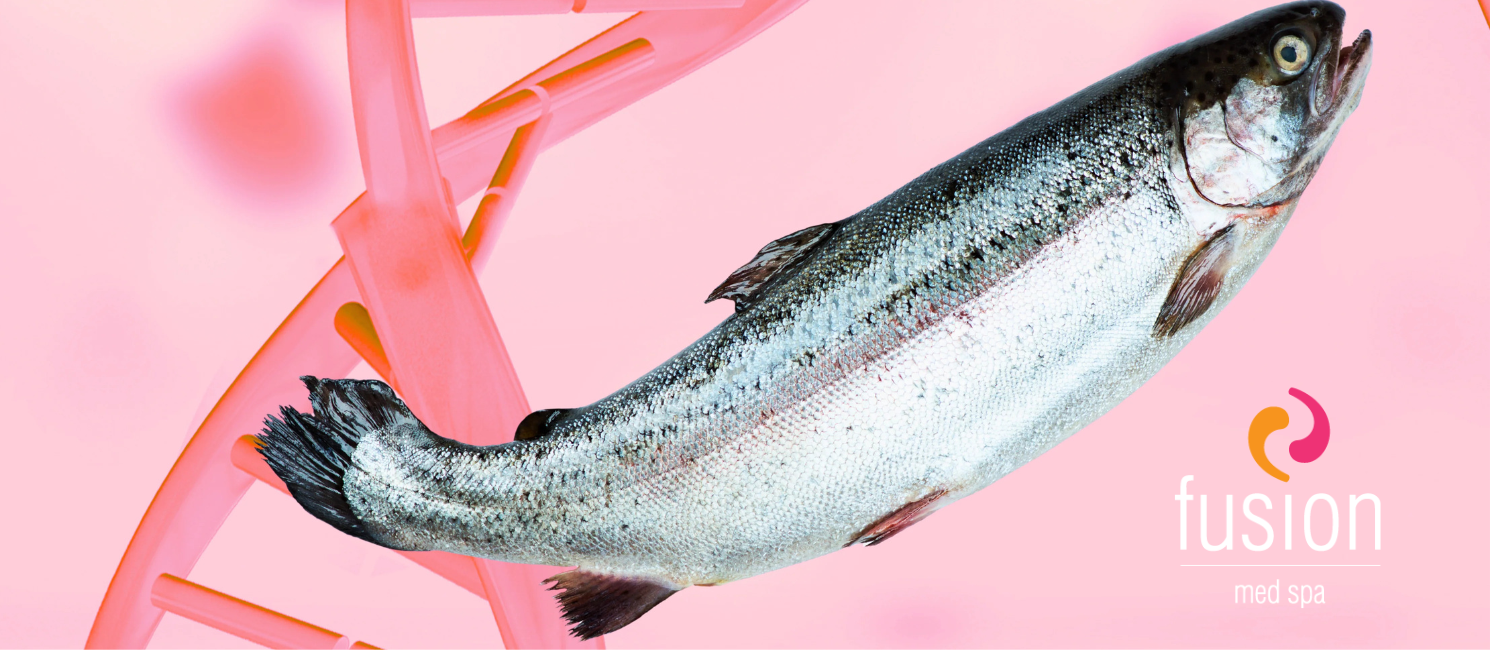
The Salmon DNA Facial Naperville Is Talking About — And the Science Behind It
If you’ve been on TikTok lately, you’ve probably seen it — someone getting a “salmon sperm facial” and either grimacing or glowing, depending on where they are in the video.
Here’s the thing: the name is doing a lot of heavy lifting. What’s actually happening is one of the most scientifically interesting regenerative skin treatments to come out of aesthetic medicine in years — and it’s been used clinically in South Korea for over two decades under the name Rejuran. The US is just catching up.
At Fusion Med Spa in Naperville, we use PDRN (polydeoxyribonucleotide) — pharmaceutical-grade salmon DNA — as part of every BioTouch Precision™ microneedling session. Not as a trend. Not because it’s having a moment on social media. Because the clinical evidence is strong, it fits our inside-out philosophy of skin regeneration, and it delivers results that standard microneedling alone simply can’t.
Curious about PDRN microneedling or the salmon DNA facial in Naperville? Call or text 630-451-8509 to schedule your consultation.
Let’s break down what it actually is, how it works, and why we chose it over PRP and synthetic growth factors.
What Is PDRN — and Why Is It Derived from Salmon?
PDRN stands for polydeoxyribonucleotide — a mouthful that essentially means purified DNA fragments. Those fragments come from salmon sperm DNA, which sounds alarming until you understand what’s actually being used.
The purification process removes every protein from the salmon DNA. What’s left are raw nucleotides — the fundamental building blocks of DNA — stripped of anything that could trigger an immune response or be recognized as foreign by the body. And here’s why salmon specifically: the base pair sequences in salmon DNA are structurally similar enough to human DNA that our cells recognize and absorb these nucleotides through what’s called the salvage pathway — the same mechanism cells use to recycle and reuse their own DNA components.
So the body isn’t processing a foreign signal. It’s receiving familiar biological raw material and putting it directly to work. That’s why PDRN is biocompatible in a way that fully synthetic compounds simply aren’t — and why it’s been used safely in clinical settings in South Korea and Europe for over 20 years.
How PDRN Works Inside Your Skin
PDRN works through three simultaneous mechanisms — which is what sets it apart from treatments that only do one thing.
1. DNA repair at the cellular level. Skin cells accumulate DNA damage over time from UV exposure, environmental stress, and the natural aging process. PDRN supplies the nucleotide building blocks cells need to repair that damage — not by sending a signal but by providing the actual raw material for the repair process. This is the foundational difference between PDRN and synthetic growth factors: PDRN gives cells what they need to heal themselves.
2. Anti-inflammatory action. PDRN activates adenosine A2A receptors in the skin — the same receptors that regulate inflammation at the cellular level. This calms the inflammatory response without suppressing the healing process. For clients with post-inflammatory hyperpigmentation, rosacea, or reactive skin, this is clinically significant: controlled inflammation leads to better, more even results.
3. Fibroblast stimulation and collagen production. By activating A2A receptors, PDRN also triggers fibroblast activity — the cells responsible for producing collagen and elastin. New collagen forms. Skin remodels. Texture improves. Hydration increases. This happens alongside the DNA repair and anti-inflammatory action — not instead of it.
Three mechanisms. One pharmaceutical-grade serum. No blood draw, no needles, no variability.
Why Microneedling Is the Best Way to Deliver PDRN in Naperville
In South Korea, PDRN is most commonly delivered by injection — multiple tiny injections across the treatment area, sometimes called a Rejuran booster session. It works. But at Fusion Med Spa, we don’t inject. Ever.
Our approach is different — and for PDRN, it’s actually clinically advantageous. BioTouch Precision™ microneedlingcreates thousands of precise microchannels in the skin during treatment. Those channels act as direct delivery pathways — PDRN applied immediately after needling penetrates at a depth and concentration it could never reach on intact skin. Research confirms that microchannel delivery dramatically increases transdermal absorption compared to topical application alone.
And because BioTouch doesn’t require numbing cream — another Fusion differentiator — there’s no lidocaine in the skin when PDRN is delivered. That matters clinically: lidocaine has been shown to inhibit fibroblast activity, the same cells PDRN is trying to activate. Skipping the numbing cream means the fibroblasts are fully receptive when PDRN arrives. The treatment works the way it’s supposed to.
No injection. No blood draw. No numbing wait. Just pharmaceutical-grade regenerative therapy delivered exactly where it needs to go.
PDRN vs PRP — Why We Chose Salmon Over Blood
PRP — platelet-rich plasma, the “vampire facial” — is the most well-known regenerative add-on for microneedling. It works by drawing your own blood, spinning it in a centrifuge to concentrate the platelets and growth factors, and applying that concentrate to the skin. The growth factors it contains stimulate collagen production and accelerate healing.
We considered it. We chose PDRN instead. Here’s why:
| PDRN (Fusion) | PRP | |
|---|---|---|
| Source | Pharmaceutical salmon DNA | Patient’s own blood |
| Blood draw required | No | Yes — 10–20 min added |
| Concentration | Consistent every treatment | Varies by individual health |
| Anti-inflammatory | ✅ Strong — A2A receptor activation | Partial |
| Anti-melanogenic | ✅ Yes — suppresses excess pigment | No |
| Safe for pigmentation | ✅ All skin types | Limited |
| Appointment time | No added time | +20–30 min |
The consistency point is significant. PRP’s effectiveness depends on your platelet count, your health, and how well your blood centrifuges on a given day. PDRN is pharmaceutical-grade — the same concentration, the same purity, the same results every single treatment. For clients who want predictable outcomes from a series of sessions, that matters.
The anti-melanogenic property is the other major factor. PDRN has been shown to suppress melanin overproduction — making it genuinely suitable for clients with hyperpigmentation and post-inflammatory dark marks. PRP doesn’t have this property. For a practice that treats a significant volume of hyperpigmentation clients, this wasn’t a minor consideration. See our complete guide to treating age spots and hyperpigmentation in Naperville for the full picture.
PDRN vs Synthetic Growth Factors — Biological vs Lab-Engineered
Some practices use PDGF (platelet-derived growth factor) as their microneedling add-on. PDGF is a recombinant, lab-engineered protein. It’s not derived from blood and it doesn’t require a blood draw — which gives it some practical advantages over PRP. It’s also backed by solid research and FDA approvals in wound care applications.
But here’s the fundamental difference: PDGF sends one signal. PDRN gives cells what they need to send their own.
PDGF is a targeted growth factor that tells fibroblasts to produce collagen. That’s it. One message, one outcome. It does that job well.
PDRN operates at a deeper level. It supplies the raw nucleotide material cells need for DNA repair, reduces inflammation through A2A receptor activation, and stimulates fibroblasts — simultaneously. It doesn’t override the body’s healing process with an engineered signal. It supports the body’s ability to heal itself using its own mechanisms.
This distinction aligns directly with Fusion’s philosophy: we regenerate and heal, we don’t wound and patch. PDRN fits that model in a way that a single synthetic growth factor signal doesn’t. It’s the difference between handing someone the tools to fix something themselves versus just telling them what needs fixing.
The Fusion Protocol — PDRN + Italian Mesotherapy Serums
At Fusion, PDRN doesn’t work alone. Every BioTouch microneedling session layers PDRN with advanced Italian regenerative mesotherapy serums — formulated for skin regeneration, brightening, and collagen support. These aren’t generic hyaluronic acid blends. They’re targeted clinical formulations selected for each client’s specific concerns.
The two work on different mechanisms simultaneously. PDRN handles cellular repair, inflammation control, and fibroblast activation. The Italian mesotherapy serums deliver targeted brightening and regenerative actives directly into the dermis through the same open microchannels. The combination produces results that neither achieves alone.
Layer in BioRePeel CL3 for clients with significant pigmentation or texture concerns, and you have a four-component protocol — BioTouch + PDRN + Italian mesotherapy serums + BioRePeel — that no other practice in Naperville is offering. It’s the most comprehensive regenerative microneedling protocol available locally. And it’s delivered without a single injection.
Who Benefits Most from PDRN Microneedling in Naperville
PDRN microneedling is a strong option for most skin types and concerns — but it’s particularly well-suited for:
Hyperpigmentation and post-inflammatory dark marks. PDRN’s anti-melanogenic and anti-inflammatory properties make it one of the safest and most effective regenerative add-ons for clients dealing with uneven skin tone. See our microneedling for age spots article for more detail.
Sensitive or reactive skin. The anti-inflammatory action calms the healing response — clients with rosacea, reactive skin, or a history of PIH often see less redness, faster recovery, and more even results compared to standard microneedling alone.
Clients building a collagen series. PDRN accelerates recovery between sessions, meaning each treatment in a series produces stronger results than it would without the regenerative support. Clients often notice their skin responding more visibly to each successive session.
All skin tones. No heat, no synthetic signals, no variability — PDRN is safe for Fitzpatrick I–VI. Unlike some regenerative add-ons that work differently on different skin types, PDRN’s mechanism is consistent regardless of tone or type.
Anyone who wants regenerative results without injections. This is the Fusion model. Everything we do is designed to produce real, lasting skin improvement without a needle in sight.
Why Naperville Clients Are Discovering What Korea Has Known for Decades
PDRN has been used clinically in South Korea under the brand name Rejuran for over 20 years. Korean dermatologists have been prescribing it for wound healing, post-procedure recovery, and skin rejuvenation for longer than most US med spas have been offering microneedling at all. The K-beauty world has known about this ingredient for years — the US aesthetic market is finally catching up.
Fusion is already offering it in Naperville — paired with the most advanced microneedling protocol available locally and delivered through a non-injection model that makes it accessible to clients who would never consider a skin booster injection.
If you’ve been seeing “salmon DNA facial” or “salmon sperm microneedling” trending and wondering whether it’s worth looking into — it is. Just not from a TikTok. From a practice that has been treating Naperville skin since 2003 and understands exactly how to use it.
Frequently Asked Questions About PDRN Microneedling in Naperville
What is the salmon sperm facial — and is it the same as salmon sperm microneedling? Yes — the “salmon sperm facial,” “salmon DNA facial,” and “salmon sperm microneedling” trending on social media and TikTok are all referring to PDRN (polydeoxyribonucleotide) treatments. The name is sensational but the science is legitimate. PDRN is purified salmon DNA — all proteins removed, leaving only the nucleotide building blocks that human cells recognize and use for repair. It’s been used clinically in South Korea for over 20 years under the name Rejuran. At Fusion Med Spa in Naperville, we deliver it through BioTouch microneedling microchannels — no injection required. Call or text 630-451-8509.
Is PDRN better than PRP for microneedling? For most of our clients, yes — and here’s why we made the switch. PDRN is pharmaceutical-grade with consistent concentration every treatment, while PRP varies based on your individual platelet count and health. PDRN also has anti-melanogenic properties that make it safer for clients with hyperpigmentation — PRP doesn’t have this. And PDRN requires no blood draw, adding no time to your appointment. For a practice focused on predictable, consistent results without injections, PDRN is the better fit.
What’s the difference between PDRN and PDGF growth factor? PDGF is a lab-engineered synthetic protein that sends a single targeted signal to fibroblasts: produce collagen. PDRN is biologically derived from salmon DNA and works through three simultaneous mechanisms — cellular DNA repair, inflammation control, and fibroblast stimulation. PDRN supports the body’s own healing mechanisms rather than overriding them with a synthetic signal. It fits Fusion’s regenerate-and-heal philosophy more naturally than a single synthetic growth factor.
Does the salmon DNA facial involve needles or injections? At Fusion, PDRN is not injected. It’s delivered topically through the microchannels created during BioTouch Precision™ microneedling — reaching the dermis without a separate needle or injection. No blood draw, no injection, no numbing cream required. Most clients describe the BioTouch treatment itself as mild pressure with minimal discomfort.
Is the salmon DNA facial safe for darker skin tones? Yes — PDRN is safe for all Fitzpatrick skin types including IV–VI. Its anti-inflammatory and anti-melanogenic properties actually make it particularly beneficial for deeper skin tones that are more susceptible to post-inflammatory hyperpigmentation. Because there’s no heat involved, there’s no risk of triggering melanocyte stimulation.
How many PDRN microneedling sessions do I need? Most clients complete a series of 3–6 BioTouch sessions with PDRN spaced 4–6 weeks apart. PDRN supports faster recovery between sessions, meaning results often build more visibly with each treatment compared to microneedling without a regenerative add-on. We’ll give you a realistic expectation at your consultation based on your specific skin concerns. Call or text 630-451-8509.
Can PDRN be combined with other treatments? Yes — and at Fusion, it’s always part of a layered protocol. Every BioTouch session includes PDRN and advanced Italian mesotherapy serums. For clients with significant pigmentation or texture concerns, we add BioRePeel CL3 in the same session — the most comprehensive regenerative microneedling protocol available in Naperville. We can also sequence microneedling with other facial treatments as part of a longer-term skin plan.
Ready to Try the Salmon DNA Facial — Without the Needle?
If the TikTok got you curious, the science should get you excited. PDRN microneedling at Fusion Med Spa delivers pharmaceutical-grade skin regeneration through BioTouch Precision™ microchannels — no injection, no blood draw, no drama. Just real results, built session by session.
Conveniently located on Illinois Route 59 in Naperville.
Call or text us at 630-451-8509 to schedule your consultation, or join our free VIP membership at fusion.repeatmd.com for exclusive rewards and savings.
Fusion Med Spa 4931 Rte 59 #119 Naperville, IL 60564
Serving Naperville, Plainfield, Bolingbrook, Aurora, Oswego, and surrounding communities.
Individual results may vary. This content is for informational and educational purposes only and does not constitute medical advice, diagnosis, or treatment. Please consult with our team to determine if a treatment is right for you.